
Spice Quality Standards: What Importers Should Check
Buying spices internationally is not simply about finding the lowest price.
For importers, the quality of a spice can affect food safety, production performance, flavour, colour, shelf life and the consistency of the finished product.
This is why buyers should understand the relevant spice quality standards and quality parameters before placing a commercial order.
Depending on the product and destination market, important parameters can include moisture, purity, foreign matter, colour, pungency, microbiological limits, pesticide residues, aflatoxins, heavy metals and other contaminants.
In this guide, we explain the major spice quality parameters that international buyers should consider when sourcing spices from India.
What Are Spice Quality Standards?
Spice quality standards are specifications or requirements used to determine whether a spice is suitable for a particular application or market.
These requirements can cover physical characteristics, chemical composition, microbiological safety, contaminants, pesticide residues, packaging and other product attributes.
There is no single quality specification that applies identically to every spice or every country.
Requirements can vary according to the spice, product form, intended use and destination market.
For example, the quality requirements for whole red chilli may differ from those for chilli powder, while the requirements for turmeric may differ from both.
Why Are Spice Quality Standards Important?
Spices are agricultural products, which means their characteristics can vary depending on variety, growing conditions, harvesting, drying, storage and processing.
International buyers therefore need consistent specifications when purchasing commercial quantities.
Good quality control can help buyers:
- Maintain consistent product quality
- Reduce contamination risks
- Protect food safety
- Meet destination-market requirements
- Maintain consistent flavour and colour
- Reduce production problems
- Improve shelf stability
- Avoid shipment disputes
- Meet customer specifications
For exporters and importers, agreeing on quality specifications before shipment can reduce misunderstandings and commercial risks.
Main Spice Quality Parameters
The most important quality parameters depend on the particular spice, but international buyers commonly evaluate several key areas.
1. Moisture Content
Moisture is one of the most important quality parameters for dried spices.
Excessive moisture can increase the risk of mould growth, deterioration, caking and reduced shelf stability.
Buyers should therefore specify an acceptable moisture range based on the product and intended application.
Moisture requirements can differ between whole spices and powdered products.
2. Foreign Matter
Foreign matter refers to unwanted material present in a spice shipment.
Examples may include:
- Stones
- Soil
- Stems
- Plant debris
- Insects
- Other non-spice materials
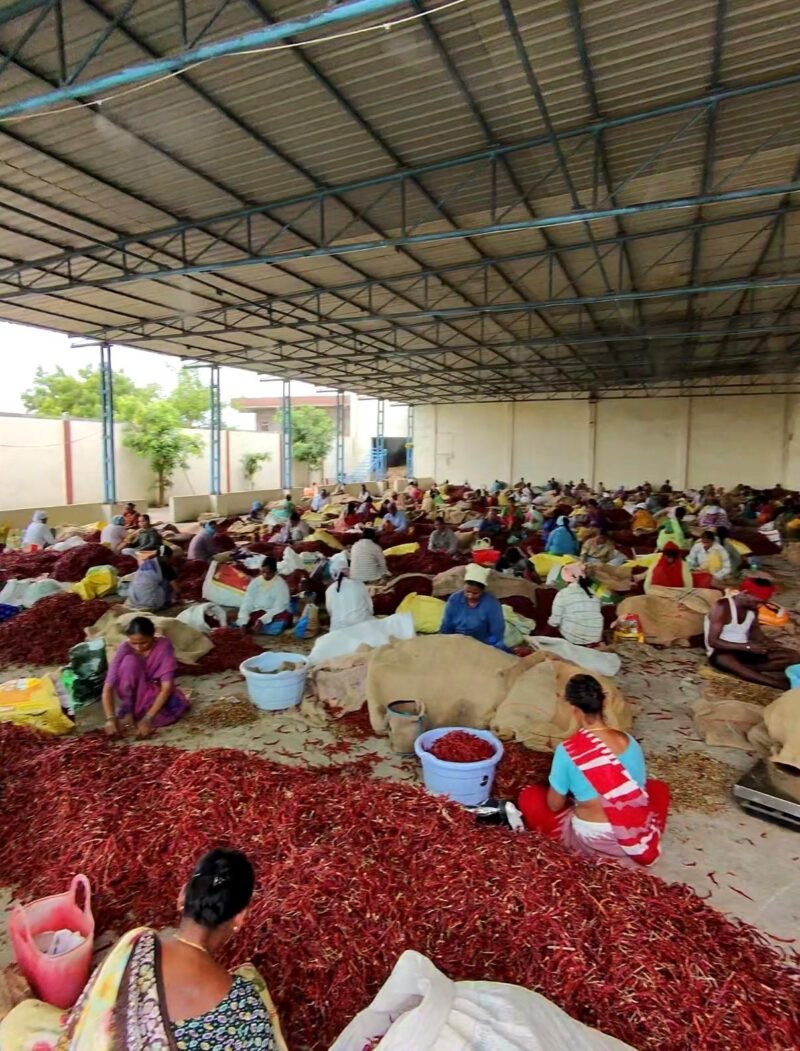
Cleaning and grading processes are important for reducing foreign matter and improving product quality.
The acceptable limit depends on the product specification and applicable standard.
3. Purity
Purity indicates how closely a spice shipment conforms to the expected product composition.
Buyers purchasing commercial spices should establish the required purity level before placing an order.
This is particularly important when the spice will be used as an ingredient in food manufacturing.
4. Colour
Colour can be an important commercial characteristic for several spices.
This is particularly relevant for products such as red chilli and turmeric.
For chilli, buyers may use colour measurements such as ASTA colour value when evaluating colour intensity.
For turmeric, buyers may evaluate colour together with curcumin content and other product characteristics.
5. Pungency
Pungency is particularly important when purchasing chilli products.
It is commonly associated with capsaicinoid content and may be expressed using Scoville Heat Units, or SHU.
Different chilli varieties can have significantly different levels of pungency.
6. Curcumin Content
Curcumin content is an important specification for many turmeric buyers.
It refers to the concentration of curcuminoids in turmeric and can influence the commercial value and intended application of the product.
Buyers should specify the required curcumin level rather than relying only on the name of a turmeric variety.
“curcumin percentage” to your Curcumin Percentage Explained article.
7. Mesh Size
Mesh size is particularly relevant when purchasing powdered spices.
It indicates the particle-size characteristics of the ground product.
Different applications may require different particle sizes.
Buyers should therefore clearly specify the required mesh size when ordering chilli powder, turmeric powder, cumin powder or other ground spices.
Microbiological Quality of Spices
Microbiological quality is an important part of food safety when importing spices.
Depending on the product and destination market, buyers may require testing for microorganisms such as Salmonella and other relevant organisms.
Microbiological requirements can vary depending on the importing country’s regulations and the intended use of the product.
Food manufacturers may have particularly strict requirements because spices can become ingredients in ready-to-eat or processed foods.
Buyers should therefore confirm the applicable microbiological specifications before shipment.
Pesticide Residues in Spices
Pesticide residues are another important consideration in international spice trade.
Different countries can establish maximum residue limits for particular pesticides and food products.
An exporter should therefore understand the requirements of the destination market rather than assuming that one pesticide specification applies globally.
Buyers may request laboratory testing or certificates demonstrating compliance with their required limits.
Aflatoxins in Spices
Aflatoxins are naturally occurring toxins produced by certain fungi under favourable conditions.
They can become a concern in agricultural commodities when products are improperly dried or stored.
Appropriate drying, storage, handling and testing can help manage the risk.
Importers may therefore include aflatoxin limits in their purchase specifications depending on the destination market and product.
Heavy Metals and Other Contaminants
International spice buyers may also specify limits for heavy metals and other contaminants.
Depending on the destination and product, testing may cover:
- Lead
- Cadmium
- Arsenic
- Mercury
- Other regulated contaminants
The exact limits should always be checked against the current requirements of the destination country.
Whole Spices vs Powdered Spices
Quality control requirements can differ between whole and powdered spices.
Whole Spices
Buyers may evaluate whole spices based on size, appearance, colour, moisture, foreign matter, purity and other parameters.
Examples include:
- Whole red chilli
- Turmeric fingers
- Cumin seeds
- Coriander seeds
- Black pepper
Powdered Spices
Powdered spices may require additional specifications relating to mesh size, particle distribution, colour, moisture and microbiological quality.
Because powdered products have undergone additional processing, buyers may require more detailed testing and specifications.
Quality Standards for Indian Spice Exports
Indian spice exporters operate within a regulatory framework that includes requirements established by Indian authorities as well as requirements imposed by destination countries.
The Spices Board of India plays an important role in the development, regulation and promotion of India’s spice industry.
Internationally recognised standards, including Codex standards where applicable, can also provide reference points for spice quality and food safety.
However, buyers should not assume that compliance with one standard automatically means compliance with every destination market.
Import requirements should always be checked for the specific country and product before shipment.
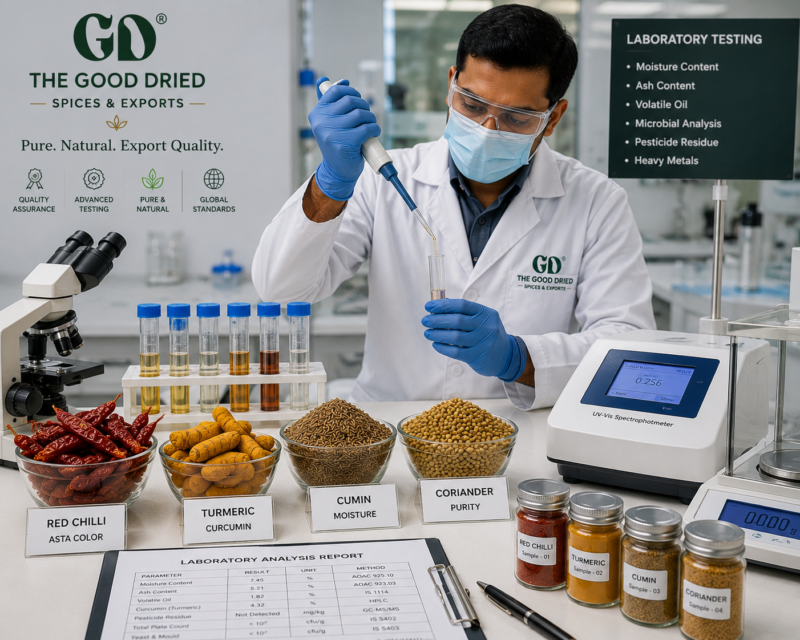
How Are Spices Tested?
Spice testing generally begins with collecting a representative sample from the product.
Depending on the product and buyer specification, testing may include:
- Physical inspection
- Moisture testing
- Purity and foreign-matter testing
- Colour measurement
- Pungency testing
- Curcumin analysis
- Microbiological testing
- Pesticide-residue testing
- Aflatoxin testing
- Heavy-metal testing
- Other destination-specific analyses
The exact test panel should be determined according to the spice, buyer specification and destination-market requirements.
What Should Importers Include in a Spice Specification?
Before requesting quotations, international buyers should prepare a clear product specification.
A commercial specification can include:
- Product name
- Variety
- Whole or powder
- Origin
- Moisture limit
- Purity
- Foreign matter
- Colour specification
- Pungency / SHU where applicable
- Curcumin percentage where applicable
- Mesh size
- Microbiological requirements
- Pesticide requirements
- Aflatoxin limits
- Heavy-metal limits
- Packaging
- Quantity
- Destination
- Required documentation
A detailed specification makes it easier for exporters to provide comparable quotations and reduces the risk of misunderstandings.
Why Samples Matter Before a Bulk Order
A product description alone cannot always communicate every quality characteristic of a spice.
International buyers should consider requesting a representative sample before committing to a large commercial shipment.
Depending on the product, buyers can evaluate the sample visually and through laboratory testing.
For repeat purchases, the approved sample can also become a reference point for future shipments.
Quality Consistency Between Shipments
Meeting the specification once is not enough for a long-term international supply relationship.
Buyers need consistency across multiple shipments.
This means suppliers should maintain appropriate sourcing, sorting, processing, testing and storage procedures.
Buyers should also clearly communicate any changes to the specification before a new production or shipment cycle.
How Importers Can Choose a Quality-Focused Indian Spice Supplier
Choosing a supplier based only on price can create quality and compliance risks.
Before placing an order, buyers should consider:
- Supplier experience
- Product knowledge
- Samples
- Testing capabilities
- Quality documentation
- Processing facilities
- Packaging capabilities
- Export experience
- Communication
- Ability to maintain consistent specifications
A reliable supplier should be able to understand the buyer’s specification and explain how the product will be sourced, processed, tested and packed.
Quality Control at The Good Dried
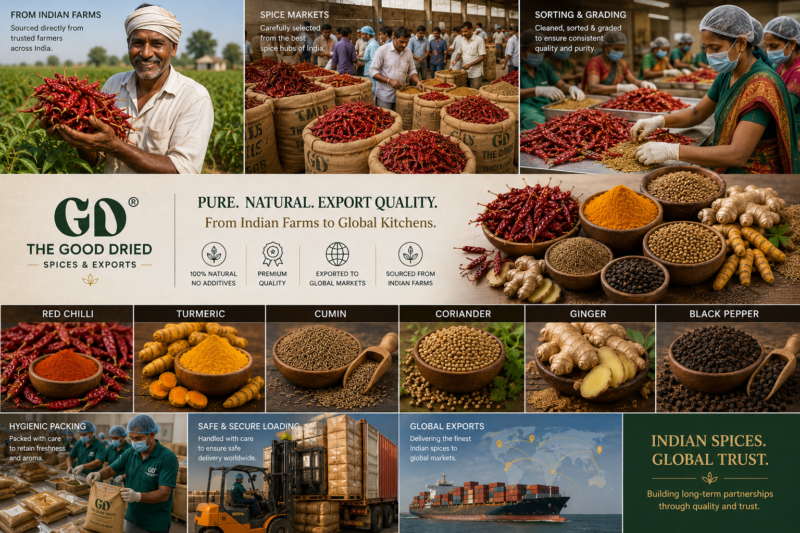
At The Good Dried, we focus on sourcing and supplying Indian agricultural ingredients according to buyer-specific requirements.
Our product focus includes Indian red chilli, turmeric and dehydrated garlic and ginger products.
For international buyers, product specifications, quantity, packaging and destination requirements are considered before finalising a supply arrangement.
Our export-focused approach includes:
- Product-specific sourcing
- Buyer specifications
- Sorting and grading
- Quality coordination
- Export packaging
- Documentation support
- Shipment coordination
Buyers can share their required product specification, quantity and destination with our team to discuss suitable sourcing options.
Request a Product Specification
Looking for Indian spices that meet your required specifications? Send us your product, quality requirements, quantity and destination.
Conclusion
Spice quality standards are an essential part of international spice sourcing.
Parameters such as moisture, purity, foreign matter, colour, pungency, curcumin, mesh size, microbiological safety, pesticide residues and contaminants can all influence whether a product meets a buyer’s requirements.
However, the exact specification depends on the spice, intended application and destination market.
International buyers should therefore define their requirements before requesting quotations and confirm applicable regulations before shipment.
A clear product specification, appropriate testing and consistent supplier communication can help create a more reliable international spice supply relationship.
Frequently Asked Questions
What are the main spice quality parameters?
Common parameters include moisture, purity, foreign matter, colour, pungency, particle size, microbiological quality, pesticide residues, aflatoxins and heavy metals.
What is the most important quality parameter for spices?
There is no single parameter that is most important for every spice. The appropriate specification depends on the product, application and destination market.
Why is moisture important in spices?
Excessive moisture can increase the risk of deterioration, mould growth and reduced shelf stability, making moisture an important parameter for dried spices.
What should I test before importing spices from India?
Depending on the product and destination, buyers may consider testing moisture, purity, foreign matter, colour, microbiological parameters, pesticide residues, aflatoxins, heavy metals and other product-specific characteristics.
Are Indian spice quality standards the same as international standards?
Not necessarily. Indian requirements and destination-country requirements can differ, so importers should verify the current requirements applicable to their specific product and market.
How can I ensure consistent spice quality?
Buyers can establish a detailed product specification, approve a representative sample, use appropriate testing and work with a supplier capable of maintaining consistent sourcing and processing standards.
Contact us today to request samples, technical specifications, or a quotation.
Website – https://thegooddried.com/
LinkedIn – https://www.linkedin.com/in/aakashkotturi/
Instagram – @gooddried
Suggested Articles
Continue exploring our guides on Indian spices, sourcing and international trade.
- Spices from India
- Indian Spices in Global Markets
- Indian Spice Exporter
- Spice Supplier from India
- ASTA Color Explained
- Curcumin Percentage Explained