
India’s Role in the Global Spice Trade
India has a broad agricultural base and an established ecosystem for producing, processing and exporting spices.
According to the Spices Board of India, India exported 17.34 lakh tonnes of spices and spice products valued at ₹39,140.11 crore, or approximately US$4.43 billion, during 2025–26.
This was compared with 17.99 lakh tonnes and US$4.72 billion in 2024–25, meaning export volume declined by approximately 4% and dollar value by approximately 6% year-on-year.
Despite the year-on-year decline, India’s spice export industry remains a major part of the country’s agricultural and food-ingredient trade.
The Spices Board also describes India as a global hub for spice processing and value addition, with more than 200 spices and value-added spice products exported to more than 180 countries.
Which Indian Spices Are Exported Globally?
India’s export basket includes a wide range of whole spices, processed spices and value-added products.
Major categories include:
- Red chilli
- Cumin
- Turmeric
- Ginger
- Black pepper
- Coriander
- Cardamom
- Fennel
- Fenugreek
- Garlic
- Curry powder and paste
- Spice oils and oleoresins
- Mint products
- Other spice seeds and products
The diversity of India’s export basket allows international buyers to source both traditional spices and processed ingredients from the country.
India’s Major Spice Exports by Value
Red chilli was the largest contributor to India’s spice export basket by value during 2025–26, accounting for approximately 27% of total spice export earnings.
Cumin and spice oils and oleoresins each contributed approximately 12%, while small cardamom contributed 9%, mint products 8% and turmeric 7%.
Curry powder and paste contributed 6%, while ginger and pepper each contributed approximately 3%, and coriander approximately 2%.
H3 — 2025–26 Export Snapshot
| Spice / Product | Approx. Share of Export Value |
|---|---|
| Red Chilli | 27% |
| Cumin | 12% |
| Spice Oils & Oleoresins | 12% |
| Small Cardamom | 9% |
| Mint Products | 8% |
| Turmeric | 7% |
| Curry Powder / Paste | 6% |
| Ginger | 3% |
| Pepper | 3% |
| Coriander | 2% |
Together, these major categories accounted for more than 90% of India’s spice export earnings during 2025–26.
Red Chilli in Global Markets
Red chilli is one of the most important Indian spice exports by both volume and value.
India exported approximately 683,681 tonnes of chilli worth US$1.177 billion during 2025–26.
Indian chilli varieties can differ significantly in pungency, colour, size and intended application.
Varieties such as Teja, Sannam, S17, 334 and Byadgi can therefore serve different requirements in international markets.
“Guntur Chilli vs Byadgi Chilli”
Turmeric in Global Markets
Turmeric is another important Indian spice used across food manufacturing, seasoning, spice blends and other applications.
India exported approximately 175,896 tonnes of turmeric worth US$327.2 million during 2025–26.
International buyers may evaluate turmeric according to factors such as curcumin content, colour, moisture, cleanliness, size and processing.
“curcumin percentage” to your Curcumin Percentage Explained article.
Cumin in Global Markets
Cumin is another major Indian spice export used in seasoning, food manufacturing and spice blends.
India exported approximately 196,800 tonnes of cumin worth US$524.22 million during 2025–26.
Buyers typically consider parameters such as purity, moisture, appearance, aroma and other product specifications when sourcing cumin.
Ginger, Pepper and Coriander
India’s export basket also includes significant quantities of ginger, black pepper and coriander.
During 2025–26, India exported approximately 146,257 tonnes of ginger, 19,806 tonnes of pepper and 60,211 tonnes of coriander.
These products serve a range of applications including food manufacturing, seasoning, spice blends and ingredient processing.
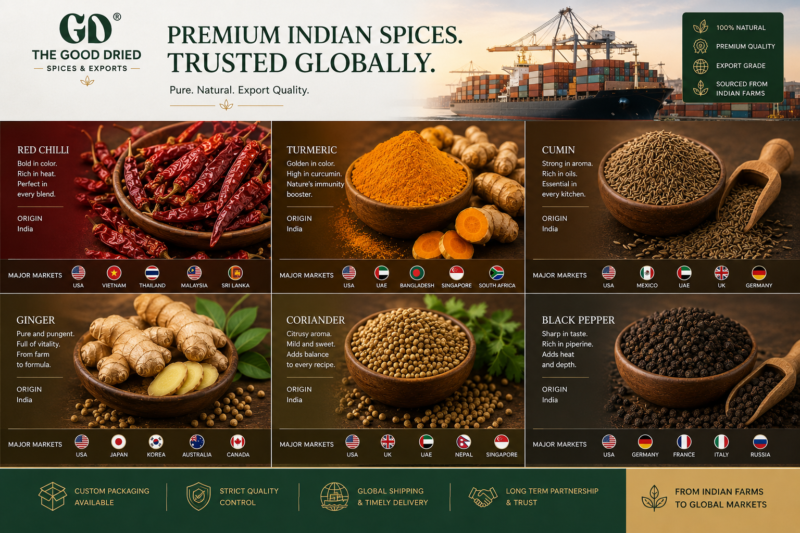
Where Are Indian Spices Exported?
Indian spices are exported to markets across Asia, the Middle East, Europe, North America and other regions.
According to the latest Spices Board data, the major destinations for Indian spices during 2025–26 included the United States, China, UAE, Bangladesh, Saudi Arabia, United Kingdom, Thailand, Malaysia and Indonesia, among others.
Major Destination Markets
| Market | Approx. Share of Indian Spice Export Earnings |
|---|---|
| USA | 14% |
| China | 12% |
| UAE | 9% |
| Bangladesh | 8% |
| Saudi Arabia | 5% |
| UK | 3% |
| Thailand | 3% |
| Malaysia | 3% |
| Indonesia | 3% |
The Spices Board reports that these and other major destinations together account for more than 85% of India’s spice export earnings.
Why Do Global Buyers Source Spices from India?
Several factors make India an important sourcing market for international spice buyers.
Wide Product Variety
Buyers can source numerous spices and different commercial varieties from India.
Large Agricultural Base
India’s diverse agricultural regions support the production of many different spice crops.
Processing Infrastructure
India has an established processing ecosystem capable of supplying whole spices, powders, blends, oils, oleoresins and other value-added products.
The Spices Board states that India has emerged from being primarily a traditional bulk-spice supplier toward becoming a global hub for spice processing and value addition.
Established Export Network
India’s spices are already supplied to a large number of international markets, giving buyers access to an established export ecosystem.
From Whole Spices to Value-Added Products
India’s role in global spice markets is no longer limited to exporting raw or whole spices.
Indian companies also supply ground spices, spice blends, curry powders and pastes, spice oils, oleoresins and other processed products.
The Spices Board reports that more than 50% of India’s spice export value is contributed by processed or value-added spice products.
This shift creates opportunities for international buyers seeking ingredients that require less processing after import.
Quality Requirements in Global Spice Markets
International spice buyers increasingly need to evaluate products according to specific quality and food-safety requirements.
Depending on the product and destination, buyers may consider:
- Moisture
- Foreign matter
- Purity
- Colour
- Pungency
- Curcumin percentage
- Mesh size
- Microbiological parameters
- Pesticide residues
- Aflatoxins
- Heavy metals
- Other destination-specific requirements
The exact requirements depend on the product, destination country and intended application.
India’s Department of Commerce notes that internationally recognised standards, including Codex standards, help provide reference benchmarks for spice quality and can support acceptance of Indian produce in global markets.
Link “spice quality standards” to your article.
Food Safety and Compliance
Food safety is a critical consideration when exporting spices to international markets.
Importers may have specific requirements relating to contaminants, pesticide residues, microbiological parameters, documentation and laboratory testing.
These requirements are not identical across every market.
For example, a specification accepted by one destination may not automatically satisfy the requirements of another destination.
Buyers and exporters should therefore establish the applicable requirements before confirming a commercial shipment.
The Government of India reported that during both 2023–24 and 2024–25, more than 99.8% of spice consignments exported from India were accepted in international markets.
What Global Buyers Should Look for in an Indian Spice Supplier
A strong global sourcing relationship requires more than competitive pricing.
International buyers should evaluate:
- Product specifications
- Supplier experience
- Samples
- Quality testing
- Food-safety compliance
- Export documentation
- Packaging
- Supply capacity
- Shipment reliability
- Communication
- Consistency between shipments
Buyers should also make sure the supplier understands the specific requirements of the destination market.
Indian Spice Export Process
A typical international spice transaction begins with the buyer providing the required product specification.
Typical process:
- Buyer sends product requirement.
- Supplier confirms availability and specification.
- Sample may be provided.
- Product testing is conducted where required.
- Commercial quotation is prepared.
- Buyer and supplier agree on terms.
- Product is sourced or processed.
- Goods are packed.
- Export documentation is prepared.
- Cargo is shipped to the destination market.
The exact process varies according to the product, destination and agreed commercial terms.
“How to Import Chilli from India”
Export Packaging for Global Spice Markets
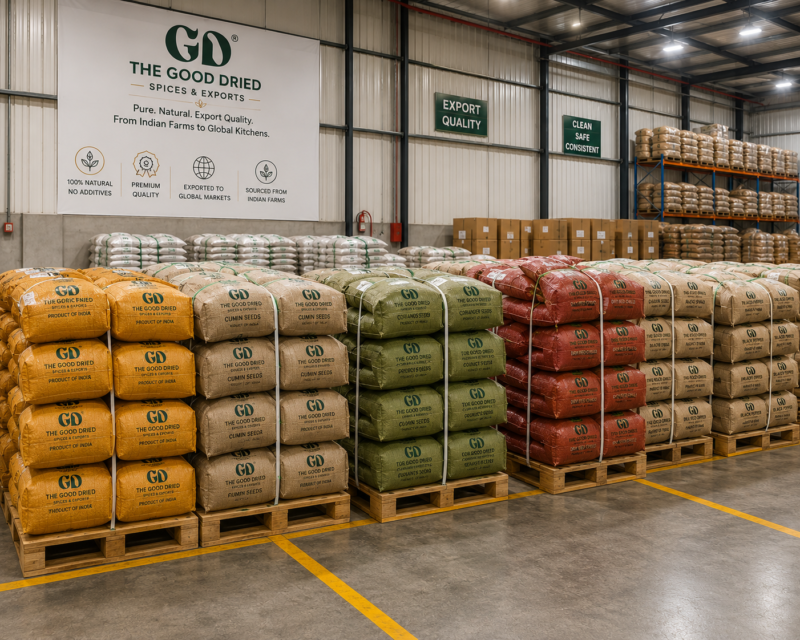
Packaging plays an important role in protecting spices during storage, handling and international transportation.
Bulk spice shipments may use bags, liners, cartons, bulk packaging or customised packaging depending on the product and buyer requirements.
Packaging should be selected based on the product’s characteristics, transportation conditions and destination requirements.
Link “Export Packaging Guide” to your article.
Major Indian Spice-Producing Regions
India’s spice production is spread across different agricultural regions, with different areas known for particular crops.
The Spices Board identifies major market centres for products including turmeric, coriander, cumin, garlic, black pepper and other spices.
Examples include:
- Guntur / Andhra Pradesh — chilli and coriander
- Erode / Tamil Nadu — turmeric
- Kadapa / Andhra Pradesh — turmeric
- Nizamabad / Telangana — turmeric and garlic
- Unjha / Gujarat — cumin and fennel
- Rajasthan — cumin, coriander and fenugreek
- Kerala — black pepper, cardamom and other spices
This geographic diversity gives buyers access to different sourcing regions and product characteristics.
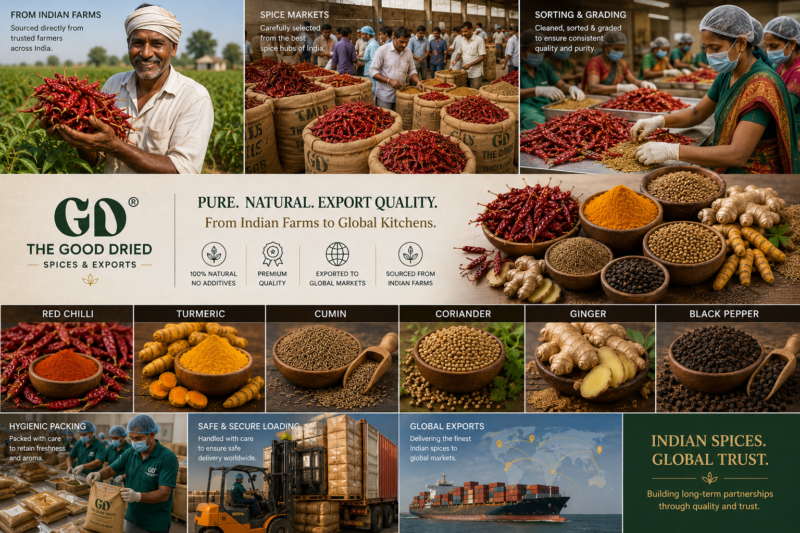
What Is Changing in the Global Indian Spice Market?
What Is Changing in the Global Indian Spice Market?
The international spice business is increasingly focused on more than simply moving bulk commodities between countries.
Buyers are placing greater emphasis on traceability, food safety, laboratory testing, consistent specifications, packaging and value-added ingredients.
India’s expanding processing infrastructure positions the country to serve buyers looking for both traditional spices and processed spice ingredients.
At the same time, exporters need to adapt to changing destination-market regulations and buyer specifications.
Opportunities for Indian Spice Exporters
The global market creates opportunities for Indian exporters across both traditional and value-added spice categories.
Potential areas include:
- Bulk whole spices
- Ground spices
- Spice blends
- Curry powders
- Spice oils
- Oleoresins
- Dehydrated ingredients
- Customized specifications
- Private-label products
- Food-manufacturing ingredients
Exporters that combine consistent quality, appropriate documentation, reliable supply and strong buyer communication can build longer-term international relationships.
The Good Dried: Indian Spices for Global Buyers
The Good Dried works with international buyers sourcing Indian agricultural products, spices and dehydrated ingredients.
Our current product focus includes Indian red chilli, turmeric and dehydrated garlic and ginger products.
We work with buyers based on their required specifications, quantities, packaging and destination requirements.
Our export approach focuses on:
- Product-specific sourcing
- Buyer specifications
- Bulk supply
- Quality coordination
- Export packaging
- Documentation support
- International shipment coordination
- Long-term buyer relationships
Buyers can share their required product, specification, quantity and destination port with our team to discuss sourcing options.
Request an Indian Spice Quote
Looking for Indian spices for your international market? Send us your product requirement, specification, quantity and destination.
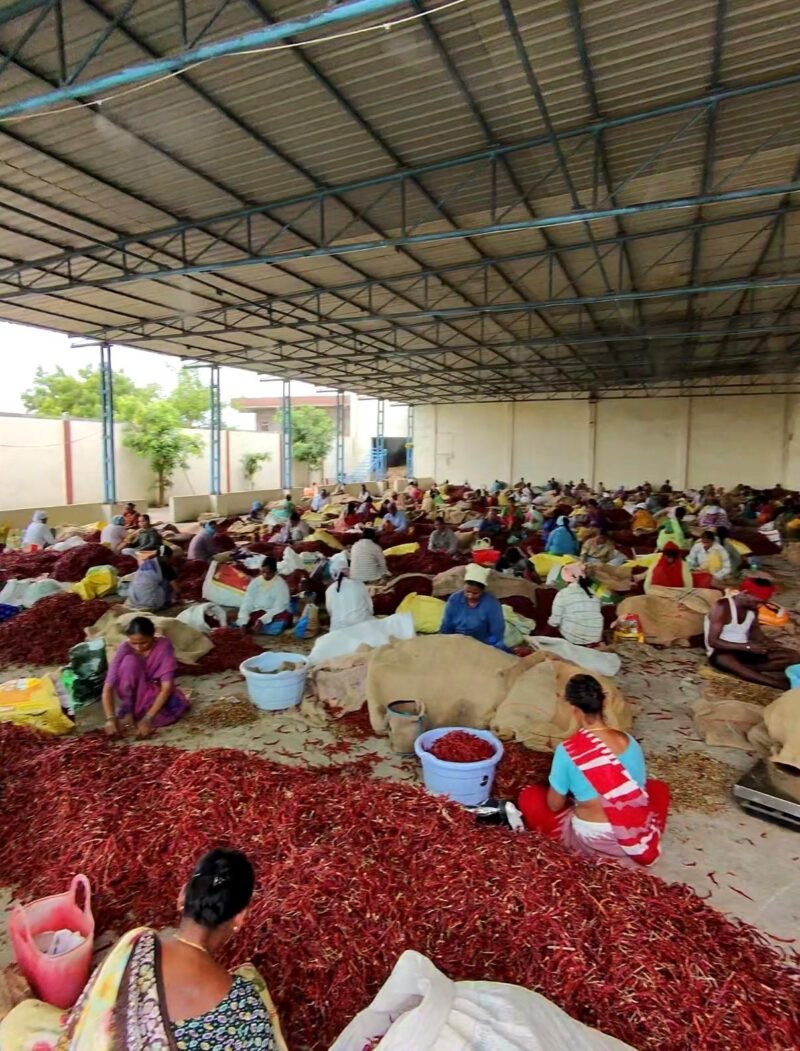
Conclusion
Indian spices continue to hold an important position in global food and ingredient markets.
From red chilli and cumin to turmeric, ginger, pepper, coriander and cardamom, India’s export basket offers a broad range of products for international buyers.
India’s established agricultural base, processing infrastructure and export network provide opportunities for buyers seeking both traditional and value-added spice products.
However, successful international sourcing depends on more than the country of origin.
Buyers should evaluate product specifications, food safety, testing, documentation, packaging, supply consistency and the capabilities of individual suppliers.
For international buyers, the right Indian spice supplier can become a long-term sourcing partner rather than simply a one-time vendor.
Frequently Asked Questions
How important are Indian spices in global markets?
India is a major participant in the international spice trade. During 2025–26, India exported 17.34 lakh tonnes of spices and spice products worth approximately US$4.43 billion.
Which Indian spices are exported the most?
Red chilli was the largest contributor to India’s spice export earnings in 2025–26, followed by cumin, spice oils and oleoresins, small cardamom, mint products and turmeric.
Which countries import Indian spices?
Major destination markets include the United States, China, UAE, Bangladesh, Saudi Arabia, the United Kingdom, Thailand, Malaysia and Indonesia.
Why do buyers source spices from India?
Buyers can access a wide range of spices, varieties and processed products through India’s established agricultural, processing and export ecosystem.
What quality parameters matter when importing Indian spices?
Depending on the product and destination, buyers may evaluate moisture, purity, colour, pungency, curcumin, microbiological parameters, pesticide residues, aflatoxins, heavy metals and other specifications.
Can Indian suppliers provide bulk spices?
Yes. Indian suppliers and exporters serve bulk commercial buyers across international markets, although product availability, minimum quantities and specifications vary between suppliers.
Contact us today to request samples, technical specifications, or a quotation.
Website – https://thegooddried.com/
LinkedIn – https://www.linkedin.com/in/aakashkotturi/
Instagram – @gooddried
Suggested Articles
Continue exploring our guides on Indian spices, sourcing and international imports.
- Spices from India
- Indian Spice Exporter
- Spice Supplier from India
- Red Chilli Exporter from India
- Turmeric Exporter from India
- How to Import Chilli from India