
Spices from India: Popular Varieties, Uses & Export Markets
India is one of the world’s major spice-producing and exporting countries, with a diverse range of spices used in food, beverages, seasoning, food processing and spice blends.
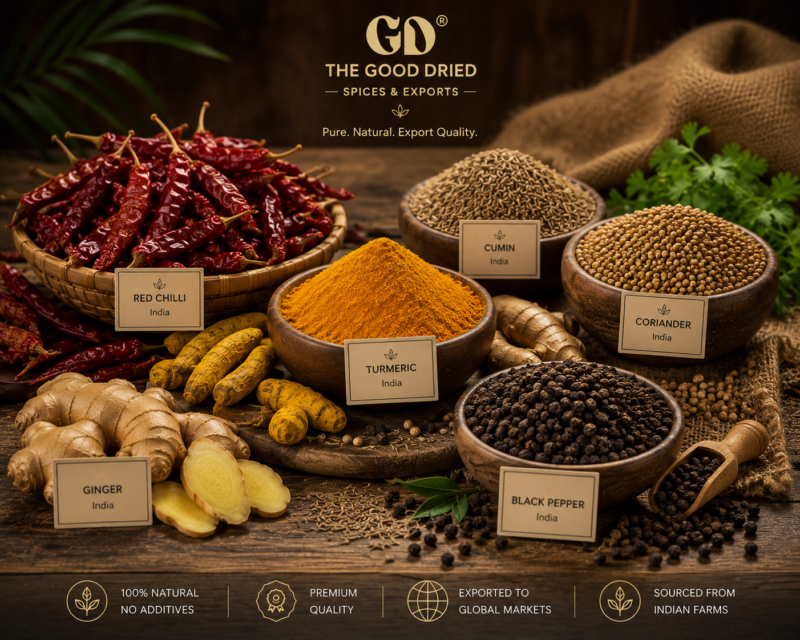
From red chilli and turmeric to cumin, coriander, ginger and black pepper, spices from India are supplied to markets around the world.
For international buyers, understanding the major Indian spices, their characteristics, applications and export markets can make sourcing decisions easier.
In this guide, we explore some of the most important spices from India, their common forms, key quality parameters and role in international trade.
Why Are Spices from India Important?
India’s diverse climate, agricultural regions and long-established spice trade have made the country an important source of spices for domestic and international markets.
The Indian spice industry includes whole spices, ground spices, spice blends, essential oils, oleoresins and other value-added products.
According to the Spices Board of India, India exported 17.34 lakh tonnes of spices and spice products worth US$4.43 billion during 2025–26.
Chilli was the largest contributor to India’s spice export basket by value at 27%, followed by cumin at 12%, spice oils and oleoresins at 12%, small cardamom at 9% and mint products at 8%. Turmeric contributed 7%.
These figures demonstrate the scale and diversity of India’s international spice trade.
What Spices Are Grown in India?
India produces a wide variety of spices across different agricultural regions.
Some important Indian spices include:
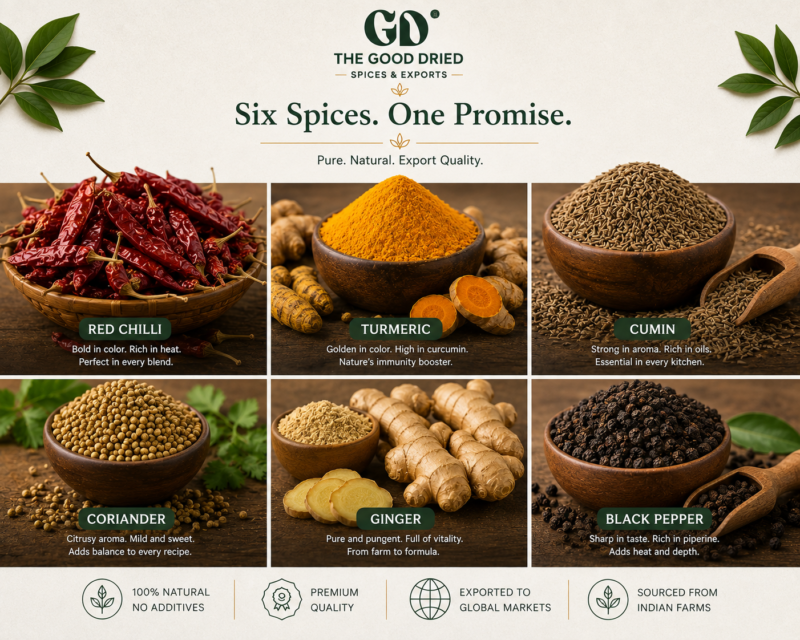
- Red chilli
- Turmeric
- Cumin
- Coriander
- Ginger
- Black pepper
- Cardamom
- Fennel
- Fenugreek
- Garlic
- Mustard
- Nutmeg
- Mace
- Tamarind
- Curry powder and spice blends
- Spice oils and oleoresins
Each spice has different varieties, growing regions, quality parameters and commercial applications.
Top Spices from India
1. Indian Red Chilli
Red chilli is one of India’s most important spice exports.
Indian red chillies are available in different varieties with varying levels of pungency, colour, size and appearance.
Popular commercial varieties include Teja, Sannam, S17, 334 and Byadgi.
Depending on the variety, Indian chillies can be used for heat, colour, flavour, food processing and oleoresin production.
2. Indian Turmeric
Turmeric is another important spice from India and is commonly traded as whole turmeric fingers and turmeric powder.
Buyers often evaluate turmeric based on parameters such as curcumin content, colour, moisture, cleanliness, size and processing quality.
Turmeric is used in food products, spice blends, seasoning, extracts and other applications.
Link “curcumin content” to your Curcumin Percentage Explained article.
3. Indian Cumin
Cumin, commonly known as jeera in India, is widely used in spice blends, seasoning and food manufacturing.
Indian cumin is available in whole and processed forms.
Buyers may evaluate cumin based on purity, moisture, appearance, aroma and other product specifications.
Cumin was the second-largest contributor to India’s spice export basket by value during 2025–26, accounting for approximately 12% of export earnings.
4. Indian Coriander
Coriander is widely used in Indian cuisine and international spice blends.
It is available as whole coriander seeds and coriander powder.
Coriander is used in seasoning, curry powders, sauces and processed food products.
5. Indian Ginger
Ginger is an important Indian spice used for its characteristic aroma and flavour.
It can be supplied in forms such as dried ginger, ginger powder and other processed products.
India’s ginger exports increased in 2025–26, with the Spices Board reporting exports of approximately 146,257 tonnes.
6. Indian Black Pepper
Black pepper is one of the best-known spices associated with India.
It is available in whole and processed forms and is widely used in seasoning, food manufacturing and spice blends.
Buyers may specify requirements related to size, density, moisture, cleanliness and other quality parameters.
7. Indian Cardamom
Cardamom is a high-value spice used in food, beverages, confectionery and traditional applications.
India exports both small and large cardamom.
Small cardamom was one of the strongest-performing major spice categories in India’s 2025–26 export data, with exports increasing substantially compared with the previous year.
Whole Spices vs Ground Spices from India
Indian spices are commonly traded in both whole and powdered forms.
Whole Spices
Whole spices are supplied in their natural or dried form and may be cleaned, graded and packed for export.
Examples include whole chilli, turmeric fingers, cumin seeds, coriander seeds and black pepper.
Ground Spices
Ground spices are processed into powders with specific particle sizes or mesh requirements.
Examples include chilli powder, turmeric powder, cumin powder and coriander powder.
Buyers purchasing powdered spices should clearly specify the required mesh size and other quality parameters.
Popular Indian Spice Varieties
One of the advantages of sourcing spices from India is the availability of multiple varieties suited to different applications.
Red Chilli Varieties
Examples include:
- Teja
- Sannam
- S17
- 334
- Byadgi
These varieties can differ significantly in colour, pungency, size and application.
Turmeric Varieties
Indian turmeric is available from different growing regions and commercial varieties.
Buyers should evaluate turmeric based on the actual specification rather than relying only on the variety name.
Curcumin percentage, moisture, colour and cleanliness can be important commercial parameters.
What Makes Indian Spices Different?
Indian spices are valued for their variety, flavour profiles, colour characteristics and availability across multiple agricultural regions.
Different growing areas can produce spices with different physical and sensory characteristics.
For international buyers, this means product selection should be based on the intended application rather than simply choosing a spice based on its country of origin.
For example, a buyer purchasing chilli for colour may require a different specification from a buyer purchasing chilli primarily for pungency.
Similarly, turmeric buyers may require different curcumin levels depending on the intended application.
Indian Spices for Food Manufacturing
Indian spices are used extensively by food manufacturers and processors.
Common applications include:
- Spice blends
- Curry powders
- Seasonings
- Sauces
- Ready-to-eat foods
- Snacks
- Pickles
- Meat products
- Instant foods
- Beverages
- Food ingredients
- Extracts and oleoresins
Commercial buyers typically require consistent specifications because spice quality can influence the taste, colour and performance of the finished product.
Quality Parameters for Indian Spices
Quality requirements vary depending on the spice, application and destination market.
Important parameters can include:
- Moisture
- Foreign matter
- Purity
- Colour
- Size
- Appearance
- Pungency
- Curcumin content
- Mesh size
- Microbiological parameters
- Pesticide residues
- Aflatoxins
- Heavy metals
- Other destination-specific requirements
Buyers should establish the required specification before requesting a quotation from an Indian spice supplier.
Link “spice quality standards” to your Spice Quality Standards article.
How Are Indian Spices Processed?
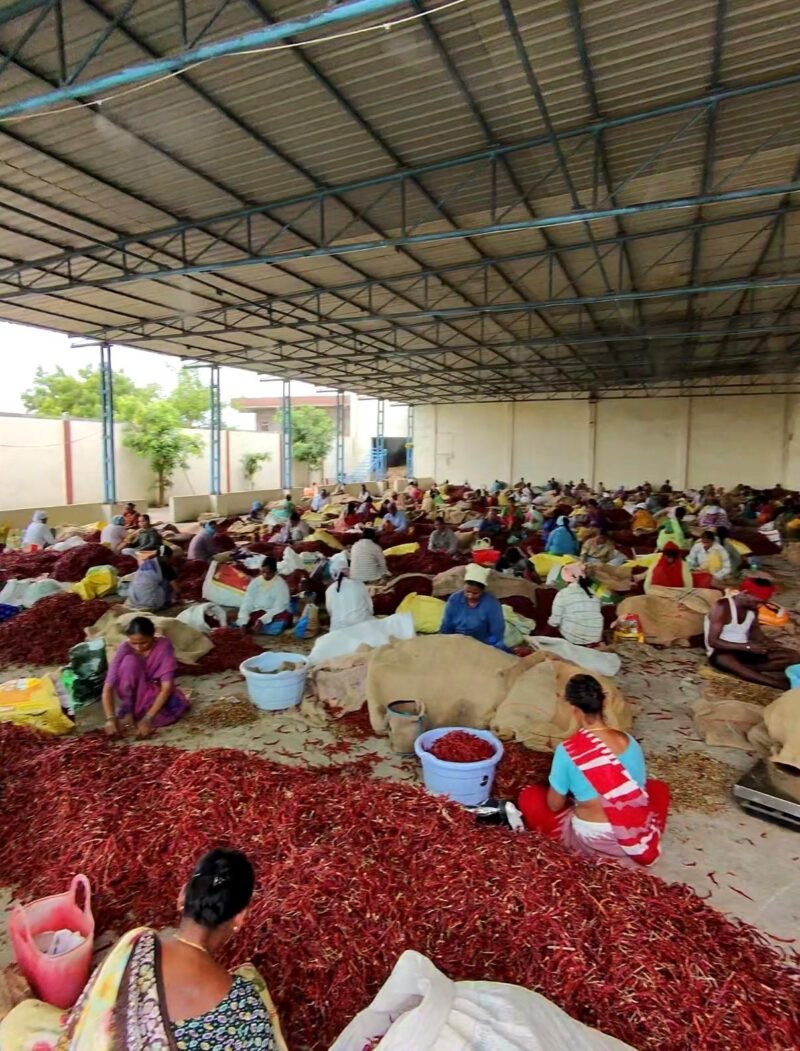
Depending on the product, Indian spices can go through several processing stages before being packed for domestic or international markets.
A typical process may include:
Raw material sourcing → Cleaning → Sorting → Grading → Processing → Testing → Packing → Storage → Export
The exact process depends on the spice and whether it is being supplied whole, crushed, powdered or further processed.
Quality control should be maintained throughout the process to help ensure that the finished product meets the agreed specification.
Link “spice processing” to your Spice Processing article.
Where Are Spices from India Exported?
Indian spices are supplied to markets across Asia, the Middle East, Europe, North America and other regions.
According to the Spices Board, the major destinations for Indian spices during 2025–26 included the United States, China, UAE, Bangladesh, Saudi Arabia, the United Kingdom, Thailand, Malaysia, Indonesia, Sri Lanka, Germany, the Netherlands, Canada, Nepal and Australia.
The United States accounted for approximately 14% of India’s spice export earnings, followed by China at 12% and the UAE at 9%.
This broad destination base demonstrates the international demand for Indian spice products.
Why Do International Buyers Source Spices from India?
International buyers may choose India because of:
- Wide product variety
- Multiple spice-growing regions
- Availability of different commercial varieties
- Established export infrastructure
- Large processing and sourcing ecosystem
- Bulk supply capabilities
- Diverse product forms
- Established international markets
However, buyers should still evaluate each supplier individually because quality, processing capabilities, certifications and specifications can vary between companies.
How to Buy Spices from India
International buyers should start by clearly defining their product requirements.
Your enquiry should include:
- Spice required
- Variety
- Whole or powdered form
- Quality specification
- Quantity
- Packaging
- Testing requirements
- Destination country
- Destination port
- Required Incoterm
Once these requirements are shared, an Indian supplier can provide a quotation based on the requested specification and commercial terms.
Export Packaging for Indian Spices
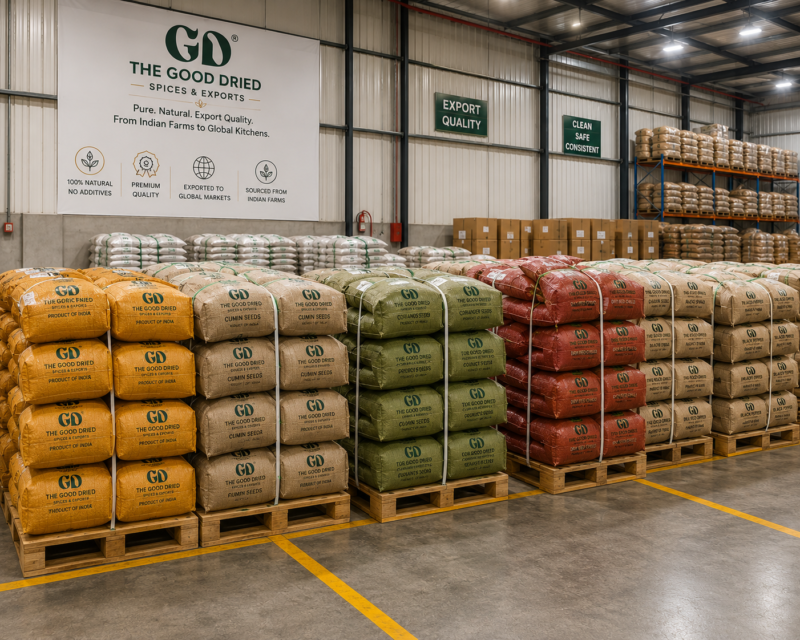
Proper packaging is important when spices are transported internationally.
Packaging should help protect the product against moisture, contamination, handling damage and other transportation risks.
Depending on the product and buyer requirements, packaging can include:
- PP bags
- Woven bags
- Paper bags
- Food-grade inner liners
- Cartons
- Bulk bags
- Palletised shipments
- Customized packaging
Packaging requirements should be agreed before production and shipment.
Link “export packaging guide” to your article.
Indian Spices and International Food Safety
Food safety is an important consideration when exporting spices to international markets.
Buyers may have specific requirements for microbiological parameters, pesticide residues, aflatoxins, heavy metals and other contaminants.
These requirements can vary according to the destination country and intended application.
Indian spice exporters should therefore understand the applicable requirements and provide the necessary documentation and testing where required.
Buyers should independently confirm the import requirements applicable to their destination market before placing an order.
Spices from India for Bulk Buyers
Indian spices can be sourced in commercial quantities for wholesalers, distributors, food manufacturers, restaurants, spice blenders and other businesses.
Bulk buyers should focus on consistent specifications rather than simply comparing the lowest price.
A reliable supply relationship should cover product quality, quantity, packaging, testing, documentation and shipment arrangements.
The Good Dried: Sourcing Spices from India
The Good Dried works with buyers looking to source Indian agricultural ingredients, spices and dehydrated products for international markets.
Our current product focus includes Indian red chilli, turmeric and dehydrated ingredients.
We work with buyers based on their required specifications, quantities, packaging and destination requirements.
Our export-oriented approach includes:
- Product sourcing
- Buyer-specific specifications
- Bulk supply
- Quality coordination
- Export packaging
- Documentation support
- International shipment coordination
International buyers can share their required product, specification, quantity and destination port with our team to discuss sourcing options.
Looking for spices from India? Send us your product requirement, specification, quantity and destination.
Conclusion
Spices from India represent a diverse and established category in international food and ingredient markets.
From red chilli, turmeric and cumin to coriander, ginger, pepper and cardamom, Indian suppliers can offer a broad range of products and specifications.
For international buyers, the most important step is to define the required specification and work with a supplier capable of consistently meeting quality, packaging and export requirements.
Whether you are sourcing whole spices, powders or bulk ingredients, India offers a wide range of options for international spice procurement.
Frequently Asked Questions
What are the most popular spices from India?
Some of the most important Indian spices include red chilli, turmeric, cumin, coriander, ginger, black pepper, cardamom and several other whole and processed spices.
What spices does India export?
India exports products including chilli, cumin, turmeric, ginger, coriander, pepper, cardamom, curry powders and pastes, spice oils and oleoresins and other spice products.
Which Indian spice is exported the most?
Red chilli was the largest contributor to India’s spice export basket by value during 2025–26, accounting for approximately 27% of export earnings from spices.
Can I buy Indian spices in bulk?
Yes. International buyers can source Indian spices in bulk depending on the product, specification, supplier capacity and destination requirements.
How do I find a spice supplier from India?
Buyers can find Indian spice suppliers through supplier websites, industry organisations, trade fairs and B2B channels.
Before placing an order, buyers should verify the supplier’s business credentials, product specifications, samples, testing and export documentation.
Which Indian spices are suitable for food manufacturers?
Red chilli, turmeric, cumin, coriander, ginger, pepper and other spices can be used in food manufacturing depending on the product and required specification.
Contact us today to request samples, technical specifications, or a quotation.
Website – https://thegooddried.com/
LinkedIn – https://www.linkedin.com/in/aakashkotturi/
Instagram – @gooddried
Suggested Articles
3. Red Chilli Exporter from India
Anchor: turmeric finger supplier
→ Your existing article.
5. Curcumin Percentage Explained