Spice Supplier from India: How to Choose the Right Supplier
India is one of the world’s major sources of spices, offering international buyers a wide range of whole spices, ground spices and value-added spice products.
For importers, food manufacturers, distributors and wholesalers, finding the right spice supplier from India can make a significant difference to product quality, pricing and supply consistency.
However, choosing a supplier should involve more than comparing prices.
Buyers should evaluate product specifications, quality control, testing, packaging, documentation, export experience and the supplier’s ability to maintain consistent quality.
This guide explains how international buyers can evaluate Indian spice suppliers and build a reliable sourcing relationship.
Why Source Spices from India?
India has a large and established spice production and export ecosystem.
According to the Spices Board, India exported 17.34 lakh tonnes of spices and spice products worth ₹39,140.11 crore, or about US$4.43 billion, during 2025–26.
Chilli, cumin, spice oils and oleoresins, small cardamom, mint products, turmeric, curry products, ginger, pepper and coriander were among the major contributors to India’s spice export basket during 2025–26.
This broad production base allows international buyers to source different spices and specifications from Indian suppliers.
India also has an established network of exporters, processors, testing facilities and logistics providers supporting international spice trade.
What Can You Buy from an Indian Spice Supplier?
Indian spice suppliers can offer a wide range of products depending on their sourcing and processing capabilities.
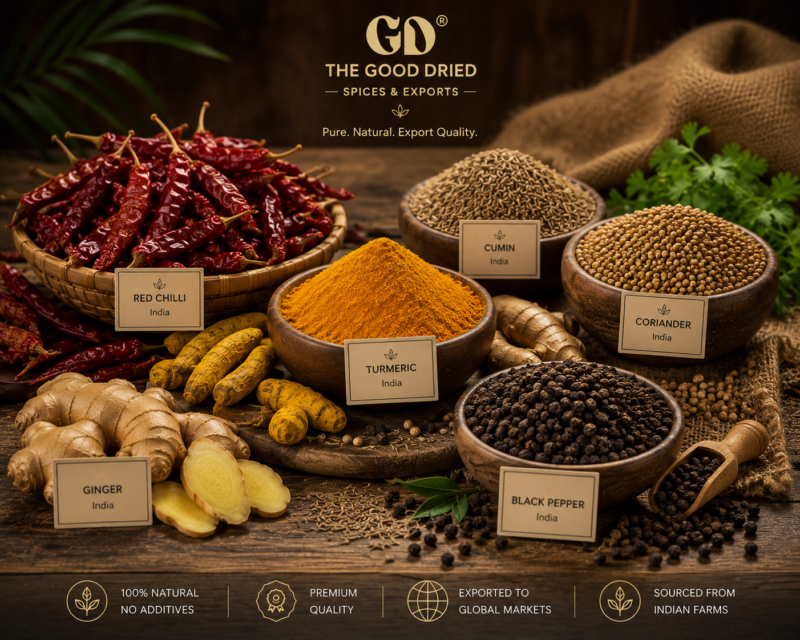
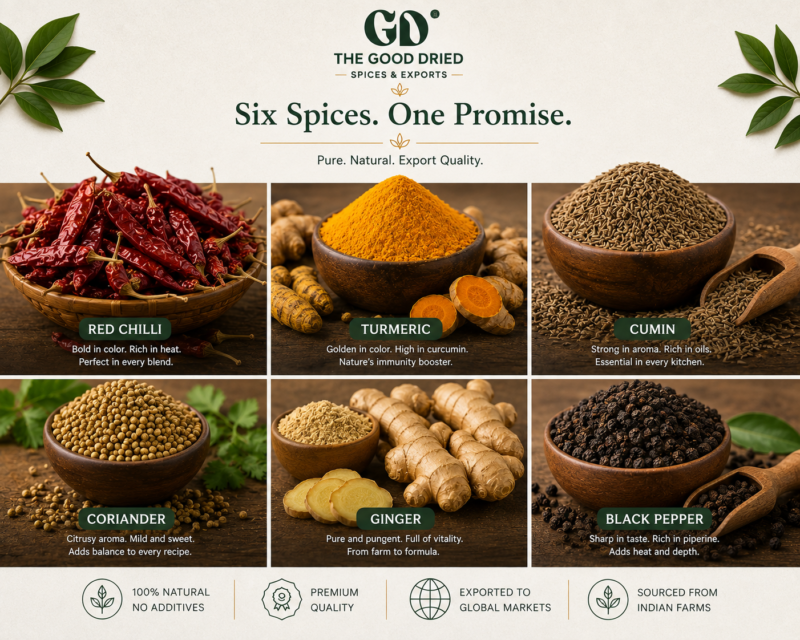
Red Chilli
Indian red chilli is available in multiple varieties and specifications based on colour, pungency, size, stem condition and intended application.
Commercial varieties can include Teja, Sannam, S17, 334 and Byadgi, among others.
Turmeric
Indian turmeric is commonly available as whole turmeric fingers and turmeric powder.
Buyers can specify requirements such as variety, curcumin percentage, moisture, cleanliness, processing and packaging.
Cumin
Indian cumin is widely used in seasoning, spice blends and food manufacturing.
Buyers can specify requirements related to purity, moisture, appearance and other quality parameters.
Coriander
Coriander is available in whole and powdered forms and is used extensively in spice blends and food products.
Ginger
Indian ginger can be sourced in different forms, including dried ginger and ginger powder.
Black Pepper
Indian black pepper is available in whole and processed forms for food and seasoning applications.
The exact availability of each product depends on the supplier, season, sourcing network and buyer requirements.
What Is the Difference Between a Spice Supplier and a Spice Exporter?
The terms spice supplier and spice exporter are sometimes used interchangeably, but they can describe different roles in the supply chain.
A spice supplier may source, process or distribute spices for domestic or international buyers.
A spice exporter specifically handles international shipments and export-related requirements.
Some companies perform both functions and supply spices directly to overseas buyers.
For international buyers, the important question is whether the supplier can consistently meet the required product specification and handle the export process.
How to Choose a Spice Supplier from India
Choosing an Indian spice supplier should begin with clearly defining what you need.
1. Define Your Product Specification
Before contacting suppliers, prepare a clear product specification.
Include:
- Spice name
- Variety
- Whole or powder
- Moisture requirement
- Colour requirement
- Pungency or SHU where applicable
- Curcumin percentage for turmeric
- Mesh size for powders
- Foreign matter limits
- Microbiological requirements
- Packaging
- Quantity
- Destination country
A clear specification makes it easier to compare quotations from different suppliers.
2. Request Samples
A product sample can help buyers evaluate whether the supplier’s material matches their requirements.
Buyers can assess physical characteristics such as appearance, colour, aroma, size and cleanliness before moving to a larger order.
Where required, samples can also be submitted for independent laboratory testing.
3. Check Laboratory Testing
Food and spice buyers should pay close attention to laboratory testing and food-safety requirements.
Depending on the spice and destination market, buyers may require testing for microbiological parameters, pesticide residues, aflatoxins, heavy metals or other contaminants.
Requirements can differ significantly between destination countries.
The Spices Board’s Export Support System also publishes information on testing and destination-specific export requirements, including advisories concerning markets such as the UK, EU, USA and Japan.
Buyer Tip: Always confirm the destination country’s current import requirements before finalising the product specification.
How to Verify an Indian Spice Supplier
Supplier verification is an important part of international sourcing.
Check Business Information
Buyers should verify the supplier’s company name, business address, contact information and relevant registration details.
Check Export Registration
Buyers sourcing spices for international shipment should also verify the supplier’s relevant export credentials.
The Spices Board provides a Certificate of Registration as Exporter of Spices, commonly known as CRES, for spice exporters.
The Spices Board also provides an online facility to verify exporter information such as registration number, firm name, IEC number, exporter category and validity.
For buyers researching supplier verification, you can reference the official Spices Board exporter verification system.
Merchant Supplier vs Manufacturer Supplier
International buyers may encounter both merchant suppliers and manufacturer suppliers when sourcing spices from India.
Merchant Supplier
A merchant supplier typically sources products from farmers, processors, manufacturers or other suppliers and supplies them to buyers.
This model can provide access to a broader range of products and sourcing locations.
Manufacturer Supplier
A manufacturer supplier processes or manufactures products within its own facility.
This can provide greater control over certain stages of processing, sorting, grinding, packing and quality management.
However, the best choice depends on the buyer’s requirements rather than the supplier category alone.
Quality Parameters to Check Before Buying Spices
Different spices require different quality parameters, but international buyers should generally discuss the following specifications with their supplier.
- Moisture
- Foreign matter
- Purity
- Colour
- Size
- Appearance
- Pungency
- Curcumin content
- Mesh size
- Microbiological quality
- Pesticide residues
- Aflatoxins
- Heavy metals
- Other destination-specific requirements
The appropriate specifications should be agreed between the buyer and supplier before the commercial order is confirmed.
Link “quality parameters” to your future Spice Quality Standards article.
Why Consistent Quality Matters
For commercial spice buyers, receiving consistent quality across multiple shipments is often more important than getting the lowest price on a single shipment.
Consistency can involve colour, moisture, pungency, cleanliness, particle size, packaging and other agreed specifications.
A reliable supplier should be able to understand the buyer’s specifications and work toward maintaining them across repeat orders.
This is especially important for food manufacturers and distributors whose finished products depend on consistent raw materials.
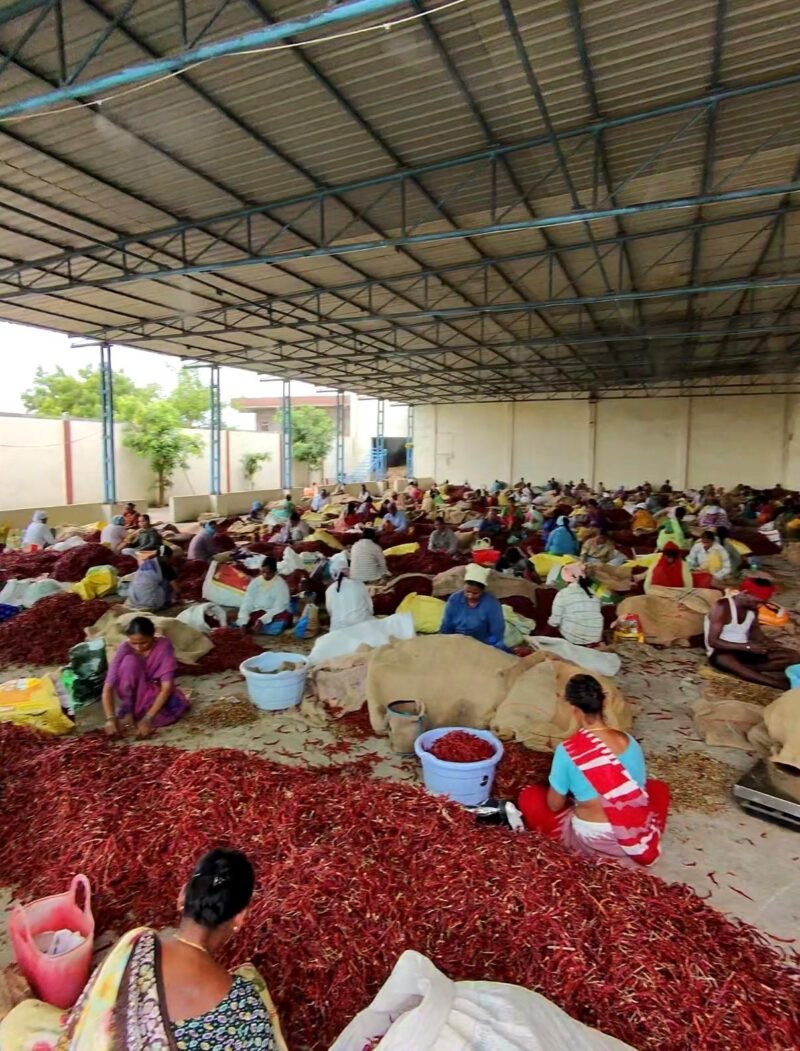
Image:
Workers sorting and grading Indian spices.
Alt Text:Indian spice supplier quality sorting and grading
File name:indian-spice-quality-sorting.jpg
Bulk Spice Supplier from India
International buyers can source Indian spices in bulk for food manufacturing, wholesale distribution, spice blending and further processing.
Bulk supply requirements should clearly specify the product, quantity, packaging, quality parameters and shipment destination.
Buyers should also confirm the supplier’s ability to maintain the required volume and specification for repeat purchases.
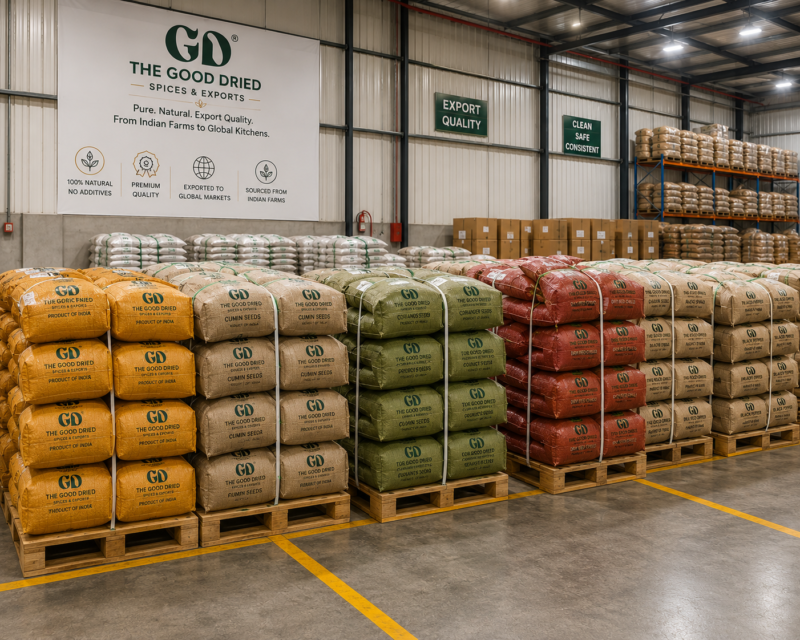
Common Bulk Packaging Options
- PP bags
- Woven bags
- Kraft paper bags
- Food-grade inner liners
- Cartons
- Palletised shipments
- Customized packaging
The appropriate packaging depends on the spice, shipment method, destination and buyer requirements.
Export Packaging for Indian Spices
Proper packaging helps protect spices from moisture, contamination, handling damage and other risks during international transportation.
Buyers should discuss packaging requirements before confirming the purchase order.
If a buyer requires private-label or customised packaging, the artwork, packaging material, dimensions and printing requirements should be confirmed in advance.
Link “export packaging” to your future Export Packaging Guide.
Documents to Request from a Spice Supplier
International buyers should discuss the documentation required for their specific product and destination market.
Potential documents may include:
- Commercial Invoice
- Packing List
- Certificate of Origin
- Bill of Lading
- Certificate of Analysis
- Phytosanitary Certificate where applicable
- Fumigation Certificate where applicable
- Health certificates where required
- Other destination-specific documents
Not every document applies to every shipment, so requirements should be confirmed before dispatch.
Link “export documentation” to your future Export Documentation Checklist.
How to Request a Quotation from an Indian Spice Supplier
A detailed enquiry helps the supplier prepare a more accurate commercial quotation.
Include:
- Product name
- Variety
- Specification
- Quantity
- Packaging
- Destination port
- Required Incoterm
- Delivery requirement
- Testing requirements
- Certification requirements
For example, instead of asking for a generic price for Indian turmeric, a buyer can specify the turmeric variety, required curcumin percentage, moisture specification, quantity, packaging and destination port.
This allows suppliers to quote against the same specification and makes supplier comparison more meaningful.
FOB vs CIF When Buying from India
International spice buyers commonly encounter Incoterms such as FOB and CIF when requesting export quotations.
Under FOB, the seller’s responsibilities generally extend to placing the goods on board the vessel at the agreed port, while the buyer arranges the main ocean freight and insurance.
Under CIF, the seller arranges the cost, insurance and freight to the named destination port, subject to the specific Incoterm terms.
Buyers should compare quotations on the same basis before deciding which supplier offers the better commercial value.
Link “FOB and CIF” to your future FOB vs CIF article.
Questions to Ask an Indian Spice Supplier
Before placing a commercial order, international buyers should ask the supplier important questions about product quality and export capability.
- What varieties do you supply?
- What specifications are available?
- Can you provide samples?
- Can you provide laboratory reports?
- What is the minimum order quantity?
- What is your monthly supply capacity?
- What packaging options are available?
- Can you provide customized packaging?
- What export documents can you provide?
- What Incoterms do you offer?
- Which ports can you ship from?
- Can you handle repeat orders?
- How do you maintain consistency between shipments?
Red Flags to Watch for When Choosing a Spice Supplier
Buyers should be cautious when a supplier cannot provide clear information about the product or transaction.
Watch for:
- Unusually low prices without explanation
- No clear product specifications
- No samples before a large order
- Unclear company information
- No quality documentation when required
- Unclear payment terms
- Pressure for immediate payment
- Inconsistent product information
- No clear export process
A professional supplier should be transparent about product specifications, commercial terms, documentation and shipment arrangements.
Why Choose an Indian Spice Supplier for Long-Term Sourcing?
India’s diverse agricultural production and established spice trade provide international buyers with multiple sourcing options.
The country’s spice export ecosystem includes producers, processors, merchant exporters, manufacturer exporters, testing facilities and logistics providers.
India’s 2025–26 spice export data shows the scale of this international trade, with the United States, China, UAE, Bangladesh, Saudi Arabia, the United Kingdom, Thailand and Malaysia among the major destination markets.
For buyers, the objective should not simply be to find an Indian supplier, but to find a supplier capable of maintaining the required quality and commercial specifications over time.
Why Buy Spices from The Good Dried?
The Good Dried works with international buyers looking to source Indian agricultural products, spices and dehydrated ingredients.
Our current product focus includes Indian red chilli, turmeric and dehydrated ingredients.
We work with buyers based on their required product specifications, quantities, packaging and destination requirements.
Buyers can share their product requirement, specification, quantity and destination port with our team for discussion.
Our sourcing approach focuses on:
- Export-oriented sourcing
- Buyer-specific specifications
- Bulk supply
- Quality coordination
- Customized packaging
- Export documentation
- International shipment support
- Long-term buyer relationships
Request a Spice Quotation: Tell us which spice you need, your required specification, quantity and destination port.
Conclusion
Finding the right spice supplier from India requires more than comparing prices.
International buyers should evaluate product specifications, quality control, laboratory testing, packaging, documentation, export capability and supply consistency.
A supplier that understands the buyer’s requirements and can consistently meet agreed specifications is more valuable than a supplier offering only the lowest initial quotation.
By evaluating these factors before placing an order, importers can build stronger and more reliable long-term sourcing relationships with Indian spice suppliers.
Frequently Asked Questions
How can I find a spice supplier from India?
International buyers can find Indian spice suppliers through industry organisations, trade events, B2B platforms, supplier websites and direct business enquiries.
Buyers should verify the supplier’s business information, export credentials, product specifications and quality documentation before placing an order.
What spices can I buy from India?
Indian suppliers can offer products including red chilli, turmeric, cumin, coriander, ginger, black pepper, cardamom and various spice products.
Can I buy spices from India in bulk?
Yes, Indian spice suppliers can provide bulk quantities depending on the product, specification, availability and supplier capacity.
How do I check the quality of Indian spices?
Buyers should request samples, review product specifications and use appropriate laboratory testing when required.
The exact tests depend on the spice, application and destination market.
Can Indian spice suppliers provide customized packaging?
Many suppliers can arrange customized packaging depending on the product, quantity, packaging material and printing requirements.
What should I include when requesting a spice quotation?
Include the spice name, variety, specifications, quantity, packaging, destination port, Incoterm and any required testing or certification.
Contact us today to request samples, technical specifications, or a quotation.
Website – https://thegooddried.com/
LinkedIn – https://www.linkedin.com/in/aakashkotturi/
Instagram – @gooddried
Suggested Articles
Red Chilli
Turmeric
Turmeric Quality
Anchor:Curcumin percentage
→ Your existing Curcumin Percentage Explained
Chilli Import
Exporter
Export Packaging
Export Packaging Guide
→ future article
Link 7 — Quality
Spice Quality Standards
→ Future article
Link 8 — Global Market
Indian Spices in Global Markets
→ Future article